.png)
Every product team right now is wrestling with the same question: how much of the customer journey do you hand to AI, and where does the human element still matter?
We recently took the stage to answer just that at Ramli John's AI Product Leaders Summit for a session called From Docs to Embedded Agents: The Evolution of Product Adoption Without Losing the Human Touch.
Christine Itwaru, VP of Product at Userflow, and Katy Nardozzi, Senior Growth Product Manager at Userflow, spent the session making the case that the best teams aren't treating this as a binary choice—they're figuring out what AI does best, what humans do best, and building their motion around both. Here are five key takeaways that matter most for product, CS, and growth teams navigating this shift.
Key Takeaways
- Embedded adoption agents guide users to task completion; they don't just answer questions the way chatbots do
- Over half of companies are already deploying or planning to deploy AI agents in customer-facing roles
- More than half of customers say excessive reliance on AI erodes brand loyalty
- The right level of automation depends on your specific user base; there is no universal playbook
- AI agents free CS teams for proactive, high-value work; automation handles volume but humans earn loyalty
- FlowAI Adoption Agent and FlowAI Signals are Userflow's answer to agent-assisted, human-led product adoption
1. The Bar for In-App Guidance Has Never Been Higher
Christine opened with a timeline of how in-app guidance has evolved—and how each shift has changed what product teams are actually responsible for delivering.
Static documentation in the early 2000s meant Word docs, screenshots, and step-by-step guides emailed across an organization: useful, but slow and outdated the moment they shipped.
The 2010s brought contextual tooltips, guided tours, and onboarding checklists—guidance became a product discipline rather than a support afterthought.
The late 2010s added AI-powered chatbots, letting users ask questions without leaving the product at all.

Today's shift to embedded agents is the one that changes the job to be done. When a user asks "How do I invite a teammate?", a chatbot returns the answer and closes the loop—the user still has to find the right page, locate the right button, and execute the steps themselves. That handoff is exactly where things fall apart.
An embedded adoption agent answers the question, surfaces the right walkthrough, and guides the user through each step to completion. The question becomes the starting line, not the finish line.
2. The Efficiency Case for AI Agents Is Proven. Now What?
The adoption curve on this one is steep. According to PwC's AI Agent Survey, over half of companies surveyed are already using or planning to deploy agents in customer-facing roles:
- 57% of companies are already using or planning to deploy agents in customer service and support roles
- 54% in sales and marketing
- 53% in IT and cybersecurity
- B2B SaaS companies using AI-driven support are seeing a 60% increase in ticket deflection

Being on the agent bandwagon is no longer a differentiator. Everyone is there or getting there. What separates the teams that win is whether they're using agents to do more than reduce ticket volume—and whether they're doing something deliberate with the capacity that gets freed up.
3. Speed and Trust Have To Go Hand In Hand
This is the part of the conversation that tends to get skipped in the rush to ship. G2's AI Agents Insights Report found that more than half of customers believe excessive reliance on AI erodes brand loyalty. And when agents go wrong, they go wrong in ways that compound:
- 33% of companies reported major reputational issues from agent failures
- 29% experienced major data leakage incidents
- 25% reported significant hallucination problems
- 26% faced major security incidents

Human oversight isn't a speed bump; it's the thing that protects the trust your product has already built. As Christine put it: If we were to deploy agents and not watch them, we open ourselves up to a ton of different moments of risk. An agent performing badly doesn't just create a bad support interaction. It creates a brand problem.
Ready to see agent-assisted onboarding in action? Start your free trial of Userflow.
4. Agents Free Your Team To Do the Work That Actually Matters
The efficiency argument for agents is real—fewer tickets, faster answers, lower cost to serve. But Christine and Katy pushed back on efficiency as the destination. The more valuable question is what your team can do with the capacity agents return to them.
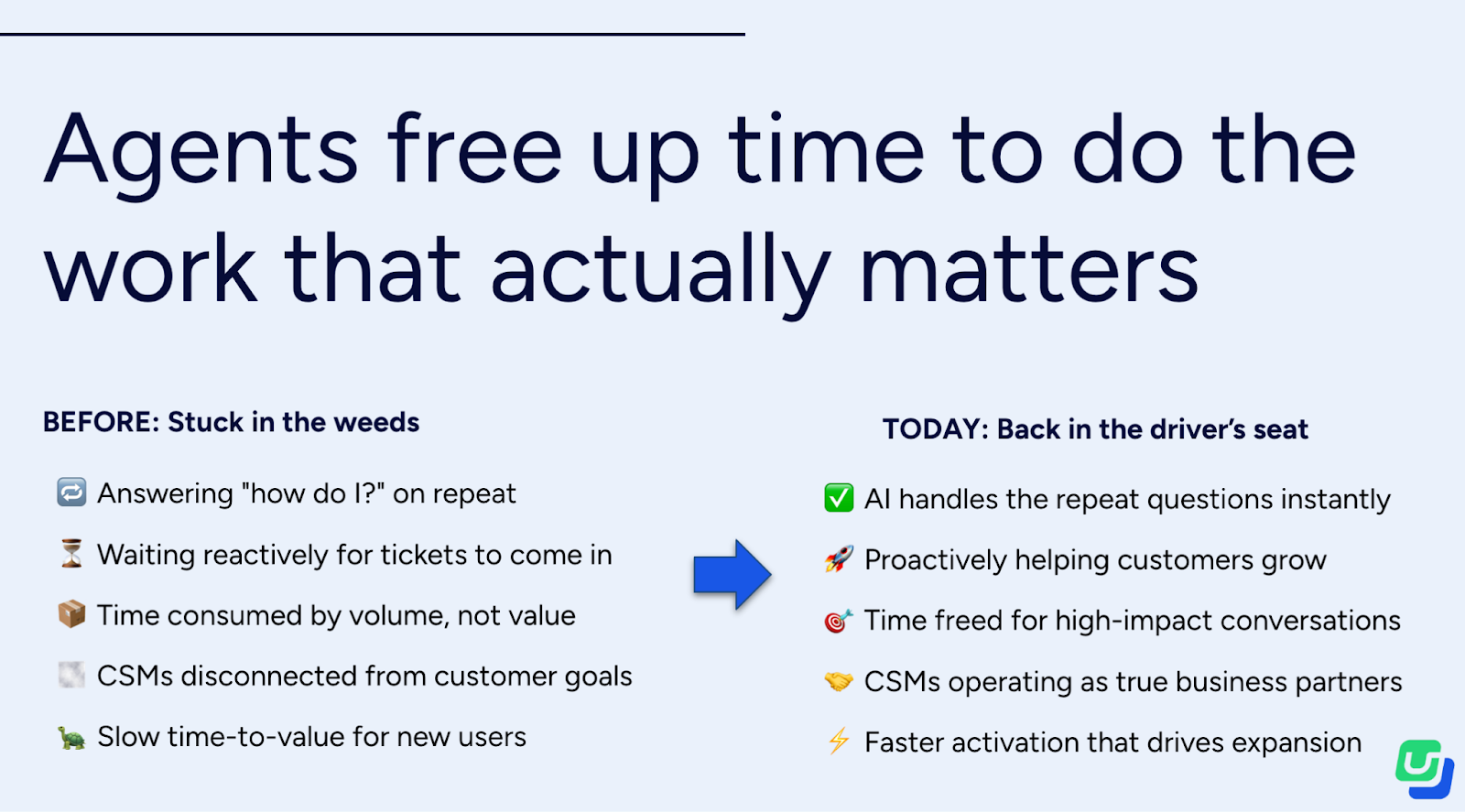
Before agents, a CS team's day is largely reactive: answering the same "how do I?" questions on repeat, waiting for tickets to come in, consumed by volume rather than value.
With agents absorbing that layer, the same team can shift to proactive work—strategic conversations, outcome reviews, identifying expansion opportunities before renewal.
Customers remember the CSM who coached them through a difficult quarter, not the ticket that got resolved in four hours. Automation can handle volume, but your team earns loyalty.
5. How Much Automation Is Right Depends On Who Your Users Are
One of the most grounding moments in the session came when Christine pushed back on the idea that there's a universal playbook for agent deployment. The right level of automation isn't a fixed answer. It depends on:
- Your product's complexity: How much guidance do users need to reach value?
- Your customer base: Are they technically confident or less experienced with SaaS tools?
- Your trust profile: Is trust easily given, or hard-won and fragile?
"Their receptiveness to the amount of automation and AI that you're putting into your product is something that you should be keeping front and center," Christine told the audience.
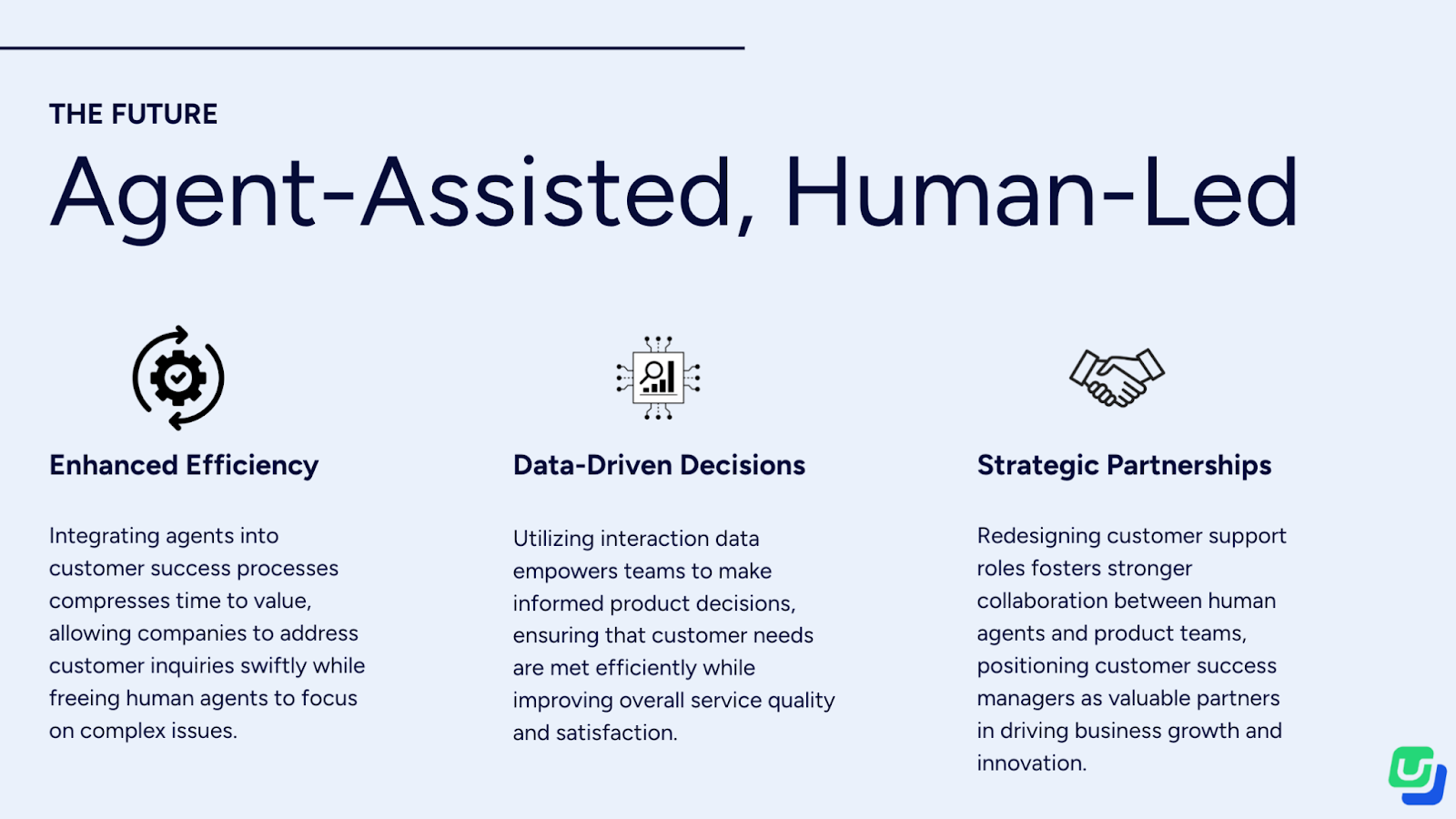
That means understanding your users before you design the experience around them. A self-serve SaaS product with a technically confident user base can lean further into automation. A product serving less experienced users, or one where trust is hard-won, may need the human layer to show up earlier and more often. Neither is wrong—but deploying agents without that awareness is where things go sideways.
The teams getting this right aren't just asking "what can we automate?" They're asking "what does our specific user base need, and where does the human element make the biggest difference?" That question, more than any technology choice, is what separates a thoughtful agent strategy from one that erodes the trust it was supposed to build.
Introducing the FlowAI Adoption Agent
Timed to the summit, Userflow launched the FlowAI Adoption Agent—the product embodiment of everything Christine and Katy covered in the session.
How It Works: The Adoption Agent lives inside your product, trained on your knowledge base, ready to answer user questions in context at any hour. But answering is just the starting point.
When a user asks "How do I invite a teammate?", the Adoption Agent responds, surfaces a "Start Walkthrough" action chip, and launches the right guided flow—walking the user through each step to completion without them leaving the product or opening a ticket.

Paired with it is FlowAI Signals, which surfaces intelligence from every agent conversation: which questions come up most, which go unanswered, which flows get triggered and launched. It's the data layer that turns agent interactions into product insights—giving your team a continuous view of where users are getting stuck before it shows up in churn. At Userflow, those signals feed directly into roadmap decisions, with CS and product meeting regularly to discuss what the data is surfacing.

Agent-assisted, human-led. Ready to see it in action? Start your free trial →
Frequently Asked Questions
What is an embedded adoption agent?
An embedded adoption agent is an AI assistant that lives inside your SaaS product, trained on your knowledge base. Unlike a chatbot that answers questions and closes the loop, an adoption agent answers the question, surfaces the relevant guided walkthrough, and takes the user through each step to task completion—without them leaving the product or opening a support ticket.
How is an adoption agent different from a chatbot?
A chatbot returns an answer. An adoption agent drives an outcome. When a user asks "how do I do X," a chatbot tells them. An adoption agent tells them and then guides them through doing it—step by step, inside the product.
What is FlowAI Adoption Agent?
The FlowAI Adoption Agent is Userflow's embedded AI agent for product adoption. It answers in-product questions, launches guided flows, and pairs with FlowAI Signals to surface product insights from every user interaction.
What is FlowAI Signals?
FlowAI Signals is Userflow's intelligence layer for in-app agent interactions. It tracks which questions users ask most, which go unanswered, and which flows get triggered—giving product and CS teams a data-backed view of where users are getting stuck.
How much automation is right for my product?
It depends on your user base. Technically confident users in self-serve SaaS can typically absorb more automation. Products serving less experienced users, or where trust is fragile, benefit from a more human-forward approach. The key is understanding your users' receptiveness to AI-driven interactions before designing the experience around them.
How do AI agents affect customer loyalty?
According to G2's AI Agents Insights Report, more than half of customers believe excessive reliance on AI erodes brand loyalty. Agents work best when they augment human touchpoints—not replace the moments where personal connection matters most.
CONTENTS

About the author



%20(2).png)
%20(2).png)