With its next-generation product, TimeTac made a deliberate strategic shift: moving away from Customer Success-only onboarding towards a model that offers both: human-led guidance where it adds the most value, and self-service for users who prefer to move at their own pace.
Particularly for smaller companies with less complex needs, the goal was to empower users to get up and running independently. As the product expanded across three languages and multiple distinct user journeys, the team saw a clear opportunity: build an in-product experience that meets every user exactly where they are.
The challenge: guiding a sophisticated product at scale
TimeTac is not a simple product, and that's precisely its strength. It's a deep, configurable time tracking platform built to serve complex teams with varied time tracking needs, multiple roles, and different technical confidence levels. That depth creates real value.
It also creates a real question every product team faces as they scale: how do you make sure users find that value quickly, regardless of where they start?
For a straightforward consumer app, little guided onboarding might be fine. For a complex B2B SaaS tool with multiple workflows, user types, and configuration paths, it was a serious problem. Users didn't know where to look, what to explore, or how the product worked.
New users had no clear next step after signing up
Churn was being driven by confusion, not product quality
There was no visibility into where users were getting stuck
Engineering time was precious, and building custom onboarding wasn't an option
"For a Product-Led Growth motion to work, users have to be able to activate themselves. Exploring tools like Userflow was a natural part of figuring out how to make that real: getting the right guidance to the right user at exactly the right moment." — Antonia Horvath, Manager, Product Engagement
Why TimeTac chose Userflow
TimeTac ran a structured evaluation. The team built a detailed feature map of their requirements and assessed multiple tools against them. Guided tours and in-product feedback collection were among the key criteria. Userflow came out on top.
What mattered most:
No-code builder that didn't require engineering involvement for day-to-day use
Ability to target flows by user behavior and segment
Multi-language support, which is critical for a product serving German, Spanish, and English-speaking markets
That last point became one of the team's most-loved capabilities. One person builds the flow; translators who have never touched Userflow can come in and add their translations directly. No training required. For a lean team operating across three languages, that workflow is a genuine advantage.
“We evaluated a number of tools against a detailed feature matrix. Userflow came out on top. It had everything we needed and didn't require us to pull in an engineer every time we wanted to make a change.” — Antonia Horvath, Manager, Product Engagement
What TimeTac built: a structured path to value
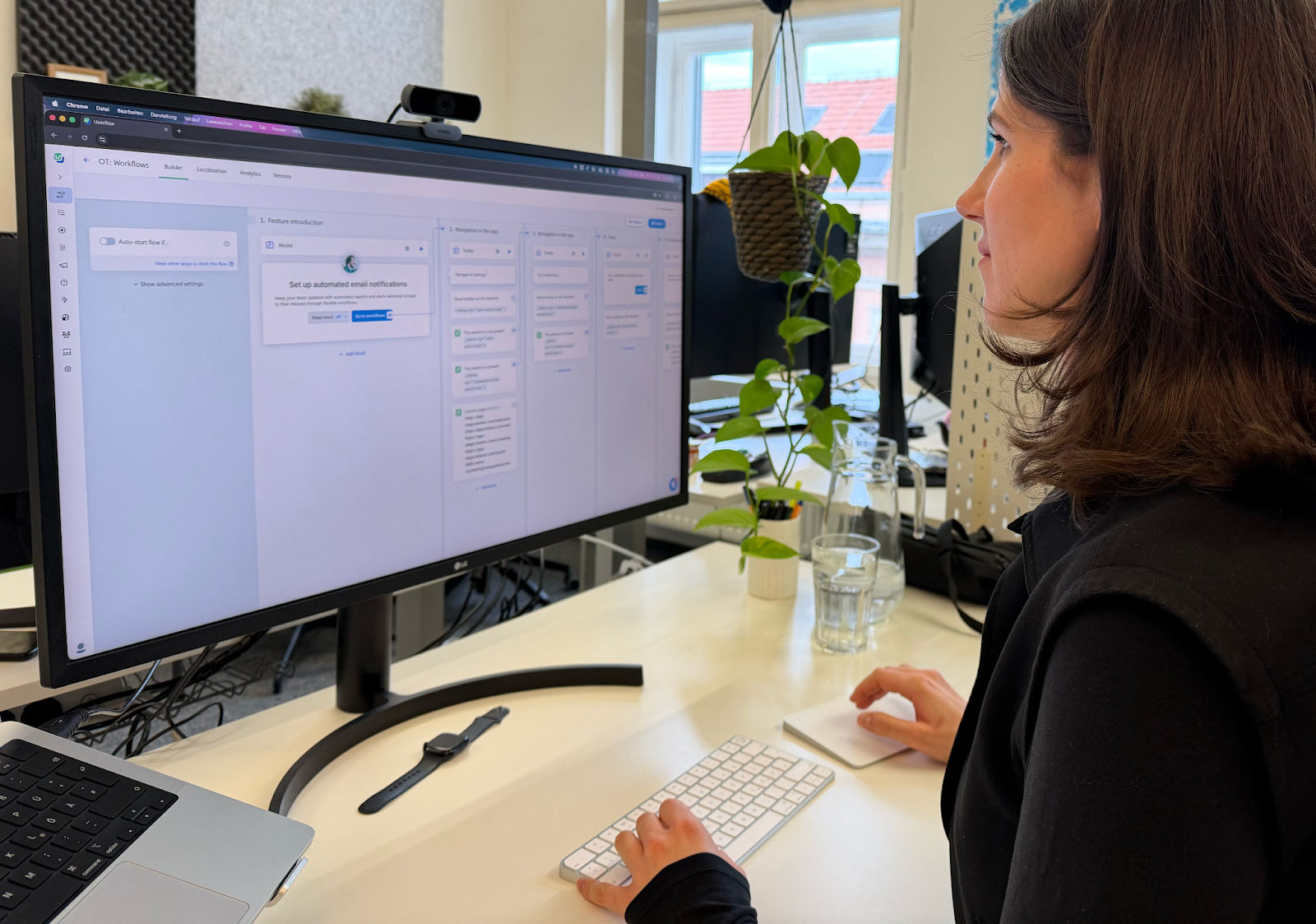
TimeTac's UX designer led the implementation, creating six onboarding tours that guide users through different areas of the product. Some foundational, some more advanced. Users land on the dashboard after signup and can access all six tours from a single entry point.
They also expanded beyond standard onboarding for their Spanish market: contextual tutorial videos surface at relevant moments in the product, with a colleague's video appearing to explain a specific feature exactly when a user needs it.
"Userflow helped us create a much clearer path through the product. Users always know what to do next—regardless of what job they had and what language they spoke." — Antonia Horvath, Manager, Product Engagement
What they implemented:
Six guided onboarding tours covering key product workflows
Checklists to create a structured path to activation
Contextual tooltips and prompts to reduce friction in real time
A resource center for on-demand help without leaving the product
Contextual video tutorials for the Spanish market
Lessons learned: Shorter beats longer
Not every tour performed equally well, and that turned out to be one of the most valuable lessons.
Tours that walked users through genuinely complex features performed well. Tours that prompted users to complete obvious, self-explanatory tasks were largely ignored. TimeTac learned that users don't want to be guided through things they can figure out on their own, but they do want meaningful help when the product asks something non-obvious of them.
The insight: build onboarding around the actions that are actually hard, not the ones that feel thorough.
The result: A product that guides users to success
TimeTac saw meaningful improvement in the areas that mattered most.
Onboarding completion up by 20%
Users follow through on setup steps they previously skipped
Activation rates improved
Users now reach key moments in the product faster
Little engineering effort, from day one
After initial setup and occasional visual anchors, very little engineering involvement needed
Feature discovery accelerated
Contextual prompts surface capabilities at the right moment
Antonia is careful to draw a distinction between feature discovery and sustained adoption: Userflow has been excellent at first-time feature explanation and getting users to encounter the right things at the right time. Tracking long-term adoption behavior is the next frontier.
The advantage of little to no engineering involvement
For a company where engineering time is scarce, one of Userflow's most practical benefits has been keeping product engagement work out of the engineering queue.
Day-to-day building, editing, and deploying of flows is handled entirely by the product and engagement team.That independence has made it easier to advocate for onboarding investment internally and faster to act on what the team observes.
"For a company where engineering time is precious, being able to build and deploy in-product experiences without constantly pulling in engineers is a big deal. Userflow makes this possible."
— Antonia Horvath, Manager, Product Engagement
What's next
TimeTac is just getting started. The team's longer-term goal is connecting Userflow with Mixpanel and Segment, moving from time- and page-based triggers to flows that fire based on actual user behavior. Rather than showing a tour when a user lands on a page, they want to show it when a user has demonstrated a specific pattern that signals they're ready for it.
That shift, from reactive onboarding to proactive, behavior-driven adoption, is where the real opportunity lies.
2 min 33 sec. read
A product that guides every user to value, without taking away time from engineers
TimeTac is a leading time tracking and workforce management platform used by teams across industries. As their product grew in depth and complexity, the team faced a challenge familiar to every fast-growing B2B product: how do you ensure that every user, regardless of role or region, reaches the value that made them sign up in the first place?
The answer was structured, in-product guidance built with Userflow. The result: faster activation, stronger retention, and a product experience that scales without adding headcount.
LEARN FROM THEIR SUCCESS
The challenges:
In-product guidance hadn't kept pace with the product's growing complexity
Users had no clear next step after signup
Key features were going undiscovered
No visibility into where users were getting stuck
Engineering time too precious to build custom flows
Why they chose Userflow:
Little to no code builder: no engineering involvement required
Contextual, in-app guidance
Checklists to drive structured activation
Resource center for self-serve, in-product support
Easy multi-language support across German, Spanish, and English
The results:
Onboarding completion increased 20%
Significant activation rate improvement
Engineering time freed for product work
Consistent experience across all user types and languages
With its next-generation product, TimeTac made a deliberate strategic shift: moving away from Customer Success-only onboarding towards a model that offers both: human-led guidance where it adds the most value, and self-service for users who prefer to move at their own pace.
Particularly for smaller companies with less complex needs, the goal was to empower users to get up and running independently. As the product expanded across three languages and multiple distinct user journeys, the team saw a clear opportunity: build an in-product experience that meets every user exactly where they are.
The challenge: guiding a sophisticated product at scale
TimeTac is not a simple product, and that's precisely its strength. It's a deep, configurable time tracking platform built to serve complex teams with varied time tracking needs, multiple roles, and different technical confidence levels. That depth creates real value.
It also creates a real question every product team faces as they scale: how do you make sure users find that value quickly, regardless of where they start?
For a straightforward consumer app, little guided onboarding might be fine. For a complex B2B SaaS tool with multiple workflows, user types, and configuration paths, it was a serious problem. Users didn't know where to look, what to explore, or how the product worked.
New users had no clear next step after signing up
Churn was being driven by confusion, not product quality
There was no visibility into where users were getting stuck
Engineering time was precious, and building custom onboarding wasn't an option
"For a Product-Led Growth motion to work, users have to be able to activate themselves. Exploring tools like Userflow was a natural part of figuring out how to make that real: getting the right guidance to the right user at exactly the right moment." — Antonia Horvath, Manager, Product Engagement
Why TimeTac chose Userflow
TimeTac ran a structured evaluation. The team built a detailed feature map of their requirements and assessed multiple tools against them. Guided tours and in-product feedback collection were among the key criteria. Userflow came out on top.
What mattered most:
No-code builder that didn't require engineering involvement for day-to-day use
Ability to target flows by user behavior and segment
Multi-language support, which is critical for a product serving German, Spanish, and English-speaking markets
That last point became one of the team's most-loved capabilities. One person builds the flow; translators who have never touched Userflow can come in and add their translations directly. No training required. For a lean team operating across three languages, that workflow is a genuine advantage.
“We evaluated a number of tools against a detailed feature matrix. Userflow came out on top. It had everything we needed and didn't require us to pull in an engineer every time we wanted to make a change.” — Antonia Horvath, Manager, Product Engagement
What TimeTac built: a structured path to value
TimeTac's UX designer led the implementation, creating six onboarding tours that guide users through different areas of the product. Some foundational, some more advanced. Users land on the dashboard after signup and can access all six tours from a single entry point.
They also expanded beyond standard onboarding for their Spanish market: contextual tutorial videos surface at relevant moments in the product, with a colleague's video appearing to explain a specific feature exactly when a user needs it.
"Userflow helped us create a much clearer path through the product. Users always know what to do next—regardless of what job they had and what language they spoke." — Antonia Horvath, Manager, Product Engagement
What they implemented:
Six guided onboarding tours covering key product workflows
Checklists to create a structured path to activation
Contextual tooltips and prompts to reduce friction in real time
A resource center for on-demand help without leaving the product
Contextual video tutorials for the Spanish market
Lessons learned: Shorter beats longer
Not every tour performed equally well, and that turned out to be one of the most valuable lessons.
Tours that walked users through genuinely complex features performed well. Tours that prompted users to complete obvious, self-explanatory tasks were largely ignored. TimeTac learned that users don't want to be guided through things they can figure out on their own, but they do want meaningful help when the product asks something non-obvious of them.
The insight: build onboarding around the actions that are actually hard, not the ones that feel thorough.
The result: A product that guides users to success
TimeTac saw meaningful improvement in the areas that mattered most.
Onboarding completion up by 20%
Users follow through on setup steps they previously skipped
Activation rates improved
Users now reach key moments in the product faster
Little engineering effort, from day one
After initial setup and occasional visual anchors, very little engineering involvement needed
Feature discovery accelerated
Contextual prompts surface capabilities at the right moment
Antonia is careful to draw a distinction between feature discovery and sustained adoption: Userflow has been excellent at first-time feature explanation and getting users to encounter the right things at the right time. Tracking long-term adoption behavior is the next frontier.
The advantage of little to no engineering involvement
For a company where engineering time is scarce, one of Userflow's most practical benefits has been keeping product engagement work out of the engineering queue.
Day-to-day building, editing, and deploying of flows is handled entirely by the product and engagement team.That independence has made it easier to advocate for onboarding investment internally and faster to act on what the team observes.
"For a company where engineering time is precious, being able to build and deploy in-product experiences without constantly pulling in engineers is a big deal. Userflow makes this possible."
— Antonia Horvath, Manager, Product Engagement
What's next
TimeTac is just getting started. The team's longer-term goal is connecting Userflow with Mixpanel and Segment, moving from time- and page-based triggers to flows that fire based on actual user behavior. Rather than showing a tour when a user lands on a page, they want to show it when a user has demonstrated a specific pattern that signals they're ready for it.
That shift, from reactive onboarding to proactive, behavior-driven adoption, is where the real opportunity lies.
About
TimeTac
TimeTac is a time and attendance system. As Product Engagement Manager, Antonia Horvath is responsible for user engagement, conversion, retention, and activation as well as a data-driven product culture.
"For a company where engineering time is precious, being able to build and deploy in-product experiences without constantly pulling in engineers is a big deal. Userflow makes this possible."

.png)