🎉 We just launched 3 new features! Find out more:

Debugger
AI Translation
AI Rephrase
blog single image
blog single image
What's New

AI Assistants Answer. Adoption Agents Act. Why the Difference Defines Your Product Adoption

blog author
Nicole Schreiber-Shearer

March 25, 2026

Your in-app AI assistant is live. Users can ask questions without leaving the product, get instant answers, and find what they need without opening a support ticket. It felt like the right move—and it was.

So when product adoption and user activation numbers don't budge, it's genuinely confusing.

The assistant is answering. You can see it in the logs. A user asked "How do I invite a teammate?" at 2pm on a Tuesday. The answer was correct, clear, complete. And yet the invite never went out. The teammate never joined. Nothing in the data tells you why. There's no failed search, no support ticket, no rage click. Just a drop somewhere in the funnel and no obvious explanation.

This isn't a reflection of bad decision-making. In-app AI assistants were a real step forward; they kept users in the product, reduced friction, and made knowledge accessible. But knowing what to do and actually doing it are two different things. That gap has always existed. What's changed is that now you can finally do something about it.

Key Takeaways

  • In-app AI assistants reduced support friction. They didn't close the gap between knowing what to do and actually doing it.
  • The biggest drop-off in your funnel happens in the knowledge-to-action gap
  • An AI assistant answers a question and stops. An AI adoption agent answers the question, recommends the right next step, and executes it.
  • When users ask “How do I…?”, they’re signaling high adoption intent
  • AI adoption agents go beyond answers by guiding users to completion inside the product
  • FlowAI Signals surfaces where the gap is widest: unanswered questions, low-confidence answers, repeated friction themes, and the flows users are most likely to need.
  • The shift from support deflection to adoption acceleration is the difference between in-app AI as overhead and in-app AI as a growth driver.

The Answer Was Right. So Why Didn't They Complete the Task?: Why AI Assistants Don’t Drive Product Adoption

The original promise of in-app AI was compelling: stop sending users to documentation. Answer questions where they are, inside the product, in context. And that was a real improvement over shipping users off to a help center and hoping they came back.

But "answering questions" set the ceiling too low for improving product adoption.

Think about what happens after a user gets an answer. The assistant has done its job. It's returned a response. The conversation is technically complete. But the user still has to translate that answer into action—find the right page, locate the right button, execute the right steps in the right order. For new or infrequent users, that translation gap is exactly where things fall apart.

In-app AI assistants made knowledge more accessible. They didn't always make completion more likely. And as any PM who's stared at a flat activation curve will tell you, completion is the only metric that actually matters.

The Knowledge-to-Action Gap in Product Adoption 

There's a point in every user journey that product teams rarely see but feel acutely: a user understands exactly what they're supposed to do and still doesn't do it.

It happens for a lot of reasons. The product is unfamiliar. The flow is slightly different from what they expected. They're not sure they're on the right page. They start, get uncertain, and stop. Or they get a solid answer from your AI assistant, switch context to try to execute it, and something breaks the flow before they get there.

This is the knowledge-to-action gap. And it's where products silently lose users every day—and where SaaS onboarding and product adoption challenges emerge.

Support tickets are often a lagging indicator of this gap. A user who submits a ticket already tried to figure it out on their own. But the majority of users who hit this wall don't submit a ticket. They just leave. Or they stay and avoid the feature. They underuse your product, reach renewal without realizing the full value, and eventually churn—with no clear signal about why.

The frustrating part is that the intent was there. That user who asked "How do I invite a teammate?" at 2pm on a Tuesday? That's peak adoption intent. That's a user who wants to complete a task. The question is whether your product is designed to capture that moment or just respond to it.

Most products, right now, are only responding.

AI Assistants vs. AI Adoption Agents

The difference between an AI assistant and an AI adoption agent isn't subtle. Here's what it looks like side by side.

Capability AI Assistant AI Adoption Agent
Answers questions Yes Yes
Recommends next action No Yes
Guides users in-product No Yes
Launches guided flows No Yes
Respects segmentation rules No Yes
Drives task completion No Yes
Surfaces intent signals No Yes
Impacts product adoption Indirect Direct

‍

What "Agentic" Actually Means for Product Teams

There's been a lot of noise lately about AI agents. But in the context of product adoption, the distinction is simple and concrete.

An AI assistant answers a question and waits.

An AI adoption agent answers the question, recommends the right next action, and takes users there.

That shift—from response to guided completion—changes everything about how in-app AI creates value. It's not a cosmetic difference. It's a fundamentally different architecture for what the AI is supposed to accomplish.

When a user asks "How do I invite a user?", the old model returns a text answer and closes the loop. The new model returns the answer, surfaces the exact walkthrough that completes the task, and launches it—redirecting the user if needed, checking any relevant segmentation rules, and guiding them step-by-step to completion.

The question became the trigger. The answer became the handoff. And a support moment became a product adoption moment.

This is the distinction that defines whether your in-app AI is a nice-to-have or a genuine adoption driver.

Introducing the FlowAI Adoption Agent

The FlowAI Adoption Agent is your concrete answer to the knowledge-to-action gap.

Formerly known as the AI Assistant, the Adoption Agent is no longer a passive chatbot. It's an AI agent embedded directly inside your customers' products so it can answer questions in context, recommend relevant walkthroughs, and launch guided flows in real time.
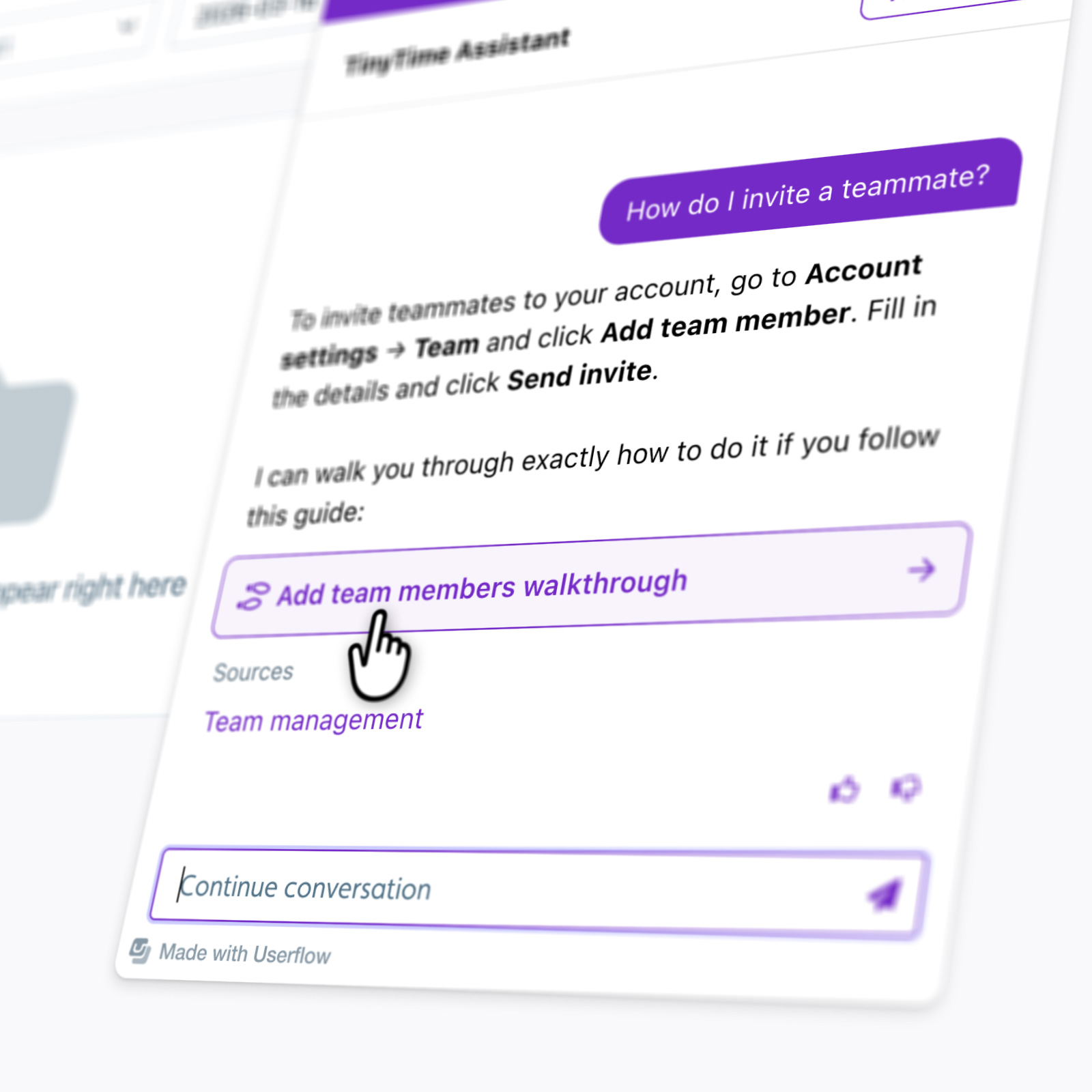
FlowAI Adoption Agent recommending an in-app walkthrough after answering a user question

Here's what that looks like in practice:

  1. Someone asks: "How do I invite a user?"
  2. The Adoption Agent responds in context, pulling from your approved knowledge base, with no hallucinations.
  3. The Adoption Agent recommends the right action, surfacing a "Start Walkthrough" action chip with the exact flow for the task.
  4. The Adoption Agent launches the flow, redirecting the user to the right URL if needed, respecting segmentation rules, and guiding them to completion step by step.

The user went from question to completion without leaving the product, opening a ticket, or searching through documentation.

That's what it means to close the knowledge-to-action gap. Answers inform. Walkthroughs convert. The Adoption Agent does both to increase product adoption and reduce onboarding friction.

What's new in this release:

  • Contextual flow recommendations in response to user questions
  • "Start Walkthrough" action chip
  • Redirect users to the correct URL if needed
  • Respect segmentation rules
  • Track when flows are triggered via the Adoption Agent

Contextual flow recommendations are available on Pro and Enterprise plans.
‍
Want to see the full question-to-completion flow in action? Book a live demo →

The Intelligence Layer: FlowAI Signals

The Adoption Agent is the execution layer. FlowAI Signals is what makes it smarter over time.

FlowAI Signals (formerly FlowAI Insights) now unifies intelligence from both product experiences and Adoption Agent interactions—giving product, CX, and growth teams a continuous view of where users struggle, what they ask, and when answers aren't enough to drive product engagement.

FlowAI Signals highlighting top friction topics and unanswered user questions

New intelligence surfaced in Signals includes:

  • Unanswered Adoption Agent questions
  • Low-confidence answers
  • Repeated "how do I?" themes
  • Frequently triggered flow recommendations
  • Flow starts via Adoption Agent

That last category is significant. When you can see which questions are most often converting into walkthrough launches, you get a clear signal of where your users' highest-intent moments are—and whether your product is meeting them.

For product managers, that means clear prioritization: deploy flows where friction is highest and intent is strongest. For CX and support teams, it means identifying knowledge base gaps before they become ticket queues. For growth and PMM, it means turning high-intent moments into measurable adoption wins.

FlowAI Signals is available on all plans. Signals → Guidance → Outcomes.

What This Means for Product Adoption Strategy: How AI Adoption Agents Improve Feature Adoption

The broader shift here is worth naming directly.

For the last several years, the primary story around in-app AI has been support deflection: fewer tickets, faster answers, reduced load on your CX team. That's a legitimate value proposition. But it's a cost-reduction story, not a growth story.

The FlowAI Adoption Agent changes the frame. When your in-app AI can detect what a user is trying to accomplish, recommend the right action, and guide them to completion, you're not just deflecting support; you're actively accelerating adoption.

Every "How do I?" question becomes a potential activation moment. Every answer becomes a potential walkthrough launch. The same interaction that previously ended with a user knowing what to do can now end with a user having done it.

That's the difference between a tool that reduces friction and a tool that drives outcomes.

From Question to Completion, Starting Now

The version of in-app AI that just answered questions served a purpose. But the gap it left—between knowing and doing—is where products silently lose users at scale. It's the part of the funnel that doesn't show up as a failure. It just shows up as flat.

The FlowAI Adoption Agent lives inside your customers' products as an active participant in the user journey, not a passive responder on the side. Not a chatbot. Not a documentation layer. The part of your product adoption strategy you didn't know you were missing.

Your users already have the intent. The Adoption Agent makes sure they have the path. Start a free trial and see it for yourself →

2 min 33 sec. read

blog single image
What's New

AI Assistants Answer. Adoption Agents Act. Why the Difference Defines Your Product Adoption

blog author
Nicole Schreiber-Shearer

March 25, 2026

Your in-app AI assistant is live. Users can ask questions without leaving the product, get instant answers, and find what they need without opening a support ticket. It felt like the right move—and it was.

So when product adoption and user activation numbers don't budge, it's genuinely confusing.

The assistant is answering. You can see it in the logs. A user asked "How do I invite a teammate?" at 2pm on a Tuesday. The answer was correct, clear, complete. And yet the invite never went out. The teammate never joined. Nothing in the data tells you why. There's no failed search, no support ticket, no rage click. Just a drop somewhere in the funnel and no obvious explanation.

This isn't a reflection of bad decision-making. In-app AI assistants were a real step forward; they kept users in the product, reduced friction, and made knowledge accessible. But knowing what to do and actually doing it are two different things. That gap has always existed. What's changed is that now you can finally do something about it.

Key Takeaways

  • In-app AI assistants reduced support friction. They didn't close the gap between knowing what to do and actually doing it.
  • The biggest drop-off in your funnel happens in the knowledge-to-action gap
  • An AI assistant answers a question and stops. An AI adoption agent answers the question, recommends the right next step, and executes it.
  • When users ask “How do I…?”, they’re signaling high adoption intent
  • AI adoption agents go beyond answers by guiding users to completion inside the product
  • FlowAI Signals surfaces where the gap is widest: unanswered questions, low-confidence answers, repeated friction themes, and the flows users are most likely to need.
  • The shift from support deflection to adoption acceleration is the difference between in-app AI as overhead and in-app AI as a growth driver.

The Answer Was Right. So Why Didn't They Complete the Task?: Why AI Assistants Don’t Drive Product Adoption

The original promise of in-app AI was compelling: stop sending users to documentation. Answer questions where they are, inside the product, in context. And that was a real improvement over shipping users off to a help center and hoping they came back.

But "answering questions" set the ceiling too low for improving product adoption.

Think about what happens after a user gets an answer. The assistant has done its job. It's returned a response. The conversation is technically complete. But the user still has to translate that answer into action—find the right page, locate the right button, execute the right steps in the right order. For new or infrequent users, that translation gap is exactly where things fall apart.

In-app AI assistants made knowledge more accessible. They didn't always make completion more likely. And as any PM who's stared at a flat activation curve will tell you, completion is the only metric that actually matters.

The Knowledge-to-Action Gap in Product Adoption 

There's a point in every user journey that product teams rarely see but feel acutely: a user understands exactly what they're supposed to do and still doesn't do it.

It happens for a lot of reasons. The product is unfamiliar. The flow is slightly different from what they expected. They're not sure they're on the right page. They start, get uncertain, and stop. Or they get a solid answer from your AI assistant, switch context to try to execute it, and something breaks the flow before they get there.

This is the knowledge-to-action gap. And it's where products silently lose users every day—and where SaaS onboarding and product adoption challenges emerge.

Support tickets are often a lagging indicator of this gap. A user who submits a ticket already tried to figure it out on their own. But the majority of users who hit this wall don't submit a ticket. They just leave. Or they stay and avoid the feature. They underuse your product, reach renewal without realizing the full value, and eventually churn—with no clear signal about why.

The frustrating part is that the intent was there. That user who asked "How do I invite a teammate?" at 2pm on a Tuesday? That's peak adoption intent. That's a user who wants to complete a task. The question is whether your product is designed to capture that moment or just respond to it.

Most products, right now, are only responding.

AI Assistants vs. AI Adoption Agents

The difference between an AI assistant and an AI adoption agent isn't subtle. Here's what it looks like side by side.

Capability AI Assistant AI Adoption Agent
Answers questions Yes Yes
Recommends next action No Yes
Guides users in-product No Yes
Launches guided flows No Yes
Respects segmentation rules No Yes
Drives task completion No Yes
Surfaces intent signals No Yes
Impacts product adoption Indirect Direct

‍

What "Agentic" Actually Means for Product Teams

There's been a lot of noise lately about AI agents. But in the context of product adoption, the distinction is simple and concrete.

An AI assistant answers a question and waits.

An AI adoption agent answers the question, recommends the right next action, and takes users there.

That shift—from response to guided completion—changes everything about how in-app AI creates value. It's not a cosmetic difference. It's a fundamentally different architecture for what the AI is supposed to accomplish.

When a user asks "How do I invite a user?", the old model returns a text answer and closes the loop. The new model returns the answer, surfaces the exact walkthrough that completes the task, and launches it—redirecting the user if needed, checking any relevant segmentation rules, and guiding them step-by-step to completion.

The question became the trigger. The answer became the handoff. And a support moment became a product adoption moment.

This is the distinction that defines whether your in-app AI is a nice-to-have or a genuine adoption driver.

Introducing the FlowAI Adoption Agent

The FlowAI Adoption Agent is your concrete answer to the knowledge-to-action gap.

Formerly known as the AI Assistant, the Adoption Agent is no longer a passive chatbot. It's an AI agent embedded directly inside your customers' products so it can answer questions in context, recommend relevant walkthroughs, and launch guided flows in real time.

FlowAI Adoption Agent recommending an in-app walkthrough after answering a user question

Here's what that looks like in practice:

  1. Someone asks: "How do I invite a user?"
  2. The Adoption Agent responds in context, pulling from your approved knowledge base, with no hallucinations.
  3. The Adoption Agent recommends the right action, surfacing a "Start Walkthrough" action chip with the exact flow for the task.
  4. The Adoption Agent launches the flow, redirecting the user to the right URL if needed, respecting segmentation rules, and guiding them to completion step by step.

The user went from question to completion without leaving the product, opening a ticket, or searching through documentation.

That's what it means to close the knowledge-to-action gap. Answers inform. Walkthroughs convert. The Adoption Agent does both to increase product adoption and reduce onboarding friction.

What's new in this release:

  • Contextual flow recommendations in response to user questions
  • "Start Walkthrough" action chip
  • Redirect users to the correct URL if needed
  • Respect segmentation rules
  • Track when flows are triggered via the Adoption Agent

Contextual flow recommendations are available on Pro and Enterprise plans.
‍
Want to see the full question-to-completion flow in action? Book a live demo →

The Intelligence Layer: FlowAI Signals

The Adoption Agent is the execution layer. FlowAI Signals is what makes it smarter over time.

FlowAI Signals (formerly FlowAI Insights) now unifies intelligence from both product experiences and Adoption Agent interactions—giving product, CX, and growth teams a continuous view of where users struggle, what they ask, and when answers aren't enough to drive product engagement.

FlowAI Signals highlighting top friction topics and unanswered user questions

New intelligence surfaced in Signals includes:

  • Unanswered Adoption Agent questions
  • Low-confidence answers
  • Repeated "how do I?" themes
  • Frequently triggered flow recommendations
  • Flow starts via Adoption Agent

That last category is significant. When you can see which questions are most often converting into walkthrough launches, you get a clear signal of where your users' highest-intent moments are—and whether your product is meeting them.

For product managers, that means clear prioritization: deploy flows where friction is highest and intent is strongest. For CX and support teams, it means identifying knowledge base gaps before they become ticket queues. For growth and PMM, it means turning high-intent moments into measurable adoption wins.

FlowAI Signals is available on all plans. Signals → Guidance → Outcomes.

What This Means for Product Adoption Strategy: How AI Adoption Agents Improve Feature Adoption

The broader shift here is worth naming directly.

For the last several years, the primary story around in-app AI has been support deflection: fewer tickets, faster answers, reduced load on your CX team. That's a legitimate value proposition. But it's a cost-reduction story, not a growth story.

The FlowAI Adoption Agent changes the frame. When your in-app AI can detect what a user is trying to accomplish, recommend the right action, and guide them to completion, you're not just deflecting support; you're actively accelerating adoption.

Every "How do I?" question becomes a potential activation moment. Every answer becomes a potential walkthrough launch. The same interaction that previously ended with a user knowing what to do can now end with a user having done it.

That's the difference between a tool that reduces friction and a tool that drives outcomes.

From Question to Completion, Starting Now

The version of in-app AI that just answered questions served a purpose. But the gap it left—between knowing and doing—is where products silently lose users at scale. It's the part of the funnel that doesn't show up as a failure. It just shows up as flat.

The FlowAI Adoption Agent lives inside your customers' products as an active participant in the user journey, not a passive responder on the side. Not a chatbot. Not a documentation layer. The part of your product adoption strategy you didn't know you were missing.

Your users already have the intent. The Adoption Agent makes sure they have the path. Start a free trial and see it for yourself →

2 min 33 sec. read

Your in-app AI assistant is live. Users can ask questions without leaving the product, get instant answers, and find what they need without opening a support ticket. It felt like the right move—and it was.

So when product adoption and user activation numbers don't budge, it's genuinely confusing.

The assistant is answering. You can see it in the logs. A user asked "How do I invite a teammate?" at 2pm on a Tuesday. The answer was correct, clear, complete. And yet the invite never went out. The teammate never joined. Nothing in the data tells you why. There's no failed search, no support ticket, no rage click. Just a drop somewhere in the funnel and no obvious explanation.

This isn't a reflection of bad decision-making. In-app AI assistants were a real step forward; they kept users in the product, reduced friction, and made knowledge accessible. But knowing what to do and actually doing it are two different things. That gap has always existed. What's changed is that now you can finally do something about it.

Key Takeaways

  • In-app AI assistants reduced support friction. They didn't close the gap between knowing what to do and actually doing it.
  • The biggest drop-off in your funnel happens in the knowledge-to-action gap
  • An AI assistant answers a question and stops. An AI adoption agent answers the question, recommends the right next step, and executes it.
  • When users ask “How do I…?”, they’re signaling high adoption intent
  • AI adoption agents go beyond answers by guiding users to completion inside the product
  • FlowAI Signals surfaces where the gap is widest: unanswered questions, low-confidence answers, repeated friction themes, and the flows users are most likely to need.
  • The shift from support deflection to adoption acceleration is the difference between in-app AI as overhead and in-app AI as a growth driver.

The Answer Was Right. So Why Didn't They Complete the Task?: Why AI Assistants Don’t Drive Product Adoption

The original promise of in-app AI was compelling: stop sending users to documentation. Answer questions where they are, inside the product, in context. And that was a real improvement over shipping users off to a help center and hoping they came back.

But "answering questions" set the ceiling too low for improving product adoption.

Think about what happens after a user gets an answer. The assistant has done its job. It's returned a response. The conversation is technically complete. But the user still has to translate that answer into action—find the right page, locate the right button, execute the right steps in the right order. For new or infrequent users, that translation gap is exactly where things fall apart.

In-app AI assistants made knowledge more accessible. They didn't always make completion more likely. And as any PM who's stared at a flat activation curve will tell you, completion is the only metric that actually matters.

The Knowledge-to-Action Gap in Product Adoption 

There's a point in every user journey that product teams rarely see but feel acutely: a user understands exactly what they're supposed to do and still doesn't do it.

It happens for a lot of reasons. The product is unfamiliar. The flow is slightly different from what they expected. They're not sure they're on the right page. They start, get uncertain, and stop. Or they get a solid answer from your AI assistant, switch context to try to execute it, and something breaks the flow before they get there.

This is the knowledge-to-action gap. And it's where products silently lose users every day—and where SaaS onboarding and product adoption challenges emerge.

Support tickets are often a lagging indicator of this gap. A user who submits a ticket already tried to figure it out on their own. But the majority of users who hit this wall don't submit a ticket. They just leave. Or they stay and avoid the feature. They underuse your product, reach renewal without realizing the full value, and eventually churn—with no clear signal about why.

The frustrating part is that the intent was there. That user who asked "How do I invite a teammate?" at 2pm on a Tuesday? That's peak adoption intent. That's a user who wants to complete a task. The question is whether your product is designed to capture that moment or just respond to it.

Most products, right now, are only responding.

AI Assistants vs. AI Adoption Agents

The difference between an AI assistant and an AI adoption agent isn't subtle. Here's what it looks like side by side.

Capability AI Assistant AI Adoption Agent
Answers questions Yes Yes
Recommends next action No Yes
Guides users in-product No Yes
Launches guided flows No Yes
Respects segmentation rules No Yes
Drives task completion No Yes
Surfaces intent signals No Yes
Impacts product adoption Indirect Direct

‍

What "Agentic" Actually Means for Product Teams

There's been a lot of noise lately about AI agents. But in the context of product adoption, the distinction is simple and concrete.

An AI assistant answers a question and waits.

An AI adoption agent answers the question, recommends the right next action, and takes users there.

That shift—from response to guided completion—changes everything about how in-app AI creates value. It's not a cosmetic difference. It's a fundamentally different architecture for what the AI is supposed to accomplish.

When a user asks "How do I invite a user?", the old model returns a text answer and closes the loop. The new model returns the answer, surfaces the exact walkthrough that completes the task, and launches it—redirecting the user if needed, checking any relevant segmentation rules, and guiding them step-by-step to completion.

The question became the trigger. The answer became the handoff. And a support moment became a product adoption moment.

This is the distinction that defines whether your in-app AI is a nice-to-have or a genuine adoption driver.

Introducing the FlowAI Adoption Agent

The FlowAI Adoption Agent is your concrete answer to the knowledge-to-action gap.

Formerly known as the AI Assistant, the Adoption Agent is no longer a passive chatbot. It's an AI agent embedded directly inside your customers' products so it can answer questions in context, recommend relevant walkthroughs, and launch guided flows in real time.

FlowAI Adoption Agent recommending an in-app walkthrough after answering a user question

Here's what that looks like in practice:

  1. Someone asks: "How do I invite a user?"
  2. The Adoption Agent responds in context, pulling from your approved knowledge base, with no hallucinations.
  3. The Adoption Agent recommends the right action, surfacing a "Start Walkthrough" action chip with the exact flow for the task.
  4. The Adoption Agent launches the flow, redirecting the user to the right URL if needed, respecting segmentation rules, and guiding them to completion step by step.

The user went from question to completion without leaving the product, opening a ticket, or searching through documentation.

That's what it means to close the knowledge-to-action gap. Answers inform. Walkthroughs convert. The Adoption Agent does both to increase product adoption and reduce onboarding friction.

What's new in this release:

  • Contextual flow recommendations in response to user questions
  • "Start Walkthrough" action chip
  • Redirect users to the correct URL if needed
  • Respect segmentation rules
  • Track when flows are triggered via the Adoption Agent

Contextual flow recommendations are available on Pro and Enterprise plans.
‍
Want to see the full question-to-completion flow in action? Book a live demo →

The Intelligence Layer: FlowAI Signals

The Adoption Agent is the execution layer. FlowAI Signals is what makes it smarter over time.

FlowAI Signals (formerly FlowAI Insights) now unifies intelligence from both product experiences and Adoption Agent interactions—giving product, CX, and growth teams a continuous view of where users struggle, what they ask, and when answers aren't enough to drive product engagement.

FlowAI Signals highlighting top friction topics and unanswered user questions

New intelligence surfaced in Signals includes:

  • Unanswered Adoption Agent questions
  • Low-confidence answers
  • Repeated "how do I?" themes
  • Frequently triggered flow recommendations
  • Flow starts via Adoption Agent

That last category is significant. When you can see which questions are most often converting into walkthrough launches, you get a clear signal of where your users' highest-intent moments are—and whether your product is meeting them.

For product managers, that means clear prioritization: deploy flows where friction is highest and intent is strongest. For CX and support teams, it means identifying knowledge base gaps before they become ticket queues. For growth and PMM, it means turning high-intent moments into measurable adoption wins.

FlowAI Signals is available on all plans. Signals → Guidance → Outcomes.

What This Means for Product Adoption Strategy: How AI Adoption Agents Improve Feature Adoption

The broader shift here is worth naming directly.

For the last several years, the primary story around in-app AI has been support deflection: fewer tickets, faster answers, reduced load on your CX team. That's a legitimate value proposition. But it's a cost-reduction story, not a growth story.

The FlowAI Adoption Agent changes the frame. When your in-app AI can detect what a user is trying to accomplish, recommend the right action, and guide them to completion, you're not just deflecting support; you're actively accelerating adoption.

Every "How do I?" question becomes a potential activation moment. Every answer becomes a potential walkthrough launch. The same interaction that previously ended with a user knowing what to do can now end with a user having done it.

That's the difference between a tool that reduces friction and a tool that drives outcomes.

From Question to Completion, Starting Now

The version of in-app AI that just answered questions served a purpose. But the gap it left—between knowing and doing—is where products silently lose users at scale. It's the part of the funnel that doesn't show up as a failure. It just shows up as flat.

The FlowAI Adoption Agent lives inside your customers' products as an active participant in the user journey, not a passive responder on the side. Not a chatbot. Not a documentation layer. The part of your product adoption strategy you didn't know you were missing.

Your users already have the intent. The Adoption Agent makes sure they have the path. Start a free trial and see it for yourself →

About the author

Content & Community Lead

Nicole is a content and community marketer who's passionate about telling stories that distill complex concepts into compelling, actionable narratives. She's spent her career writing for B2B SaaS companies and using her love of language to cultivate communities that share best practices and and come together to celebrate exciting milestones.

Effortless Onboarding,
Powerful Results

Try the most-loved user onboarding product on the market.

CASE STUDIES

All case studies
iconicon

SPARETECH

a case study

How SPARETECH Onboarded 3,000 Users Across 10 Time Zones Without Burning Out Their CSM Team

Learn how
iconicon

Klevu

a case study

How Klevu Enhanced Adoption and Reduced Time-to-Value by 50% with Userflow

Learn how
iconicon

Evocalize

a case study

How Evocalize Boosted Product Adoption and Engagement With Userflow 

Learn how
iconicon